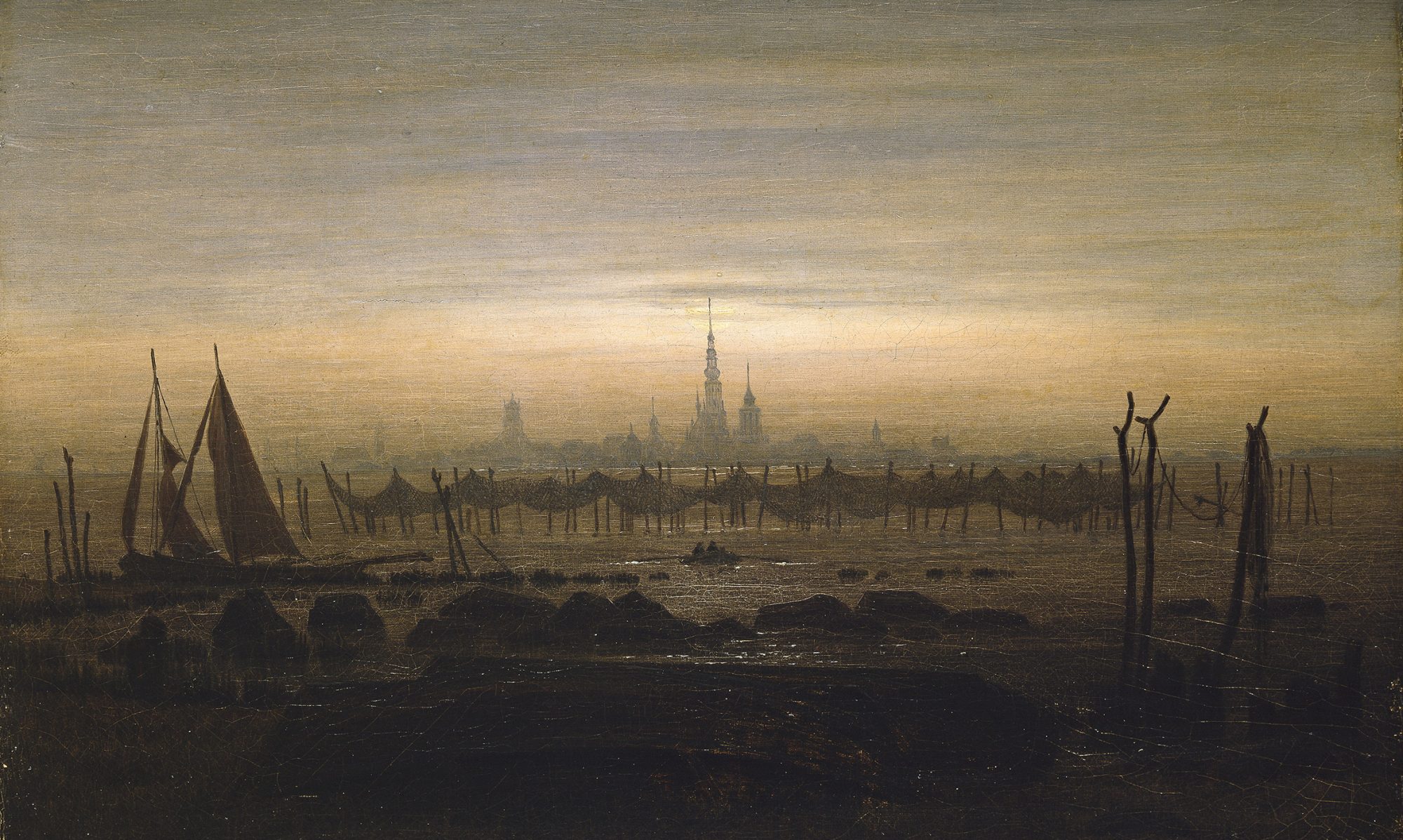
‘A View of Abbotsford from across the Tweed’

‘A View of Abbotsford from across the Tweed’

Contributor: Kirsty Archer-Thompson FSA Scot

Location: Abbotsford, the Home of Sir Walter Scott, Melrose

Description: This small and relatively unassuming painting of Abbotsford reads like a picturesque painting by numbers, with the long shadows and repoussoir tree in the foreground, an ethereal light falling on the house in the middle distance, and the receding outlines of the Eildon hills beyond, enveloped in cloud. Three figures are visible in the foreground: one astride a horse, another intently sketching or reading on the riverbank and the other casting for a fish in the Tweed. They are a curiously disconnected group of people, with the two that face the house very much ensconced in their inner worlds. On the opposite side of the riverbank, a flock of sheep complete the pastoral idyll, congregated around the Italianate stable block with its pitched roof. Above that, the house rises out of a crop of well-established shrubbery and tree cover. The building itself is executed remarkably accurately in its architecture and scale.

However, all is not quite as it seems. All the evidence suggests that this startlingly accurate painting predates the completion of the house’s east extension. What you are looking at is not so much documentation as something that is, or at least became, a very powerful piece of Romantic propaganda.

Continue reading “‘A View of Abbotsford from across the Tweed’”
Holograph Letter from Adam Smith to David Hume

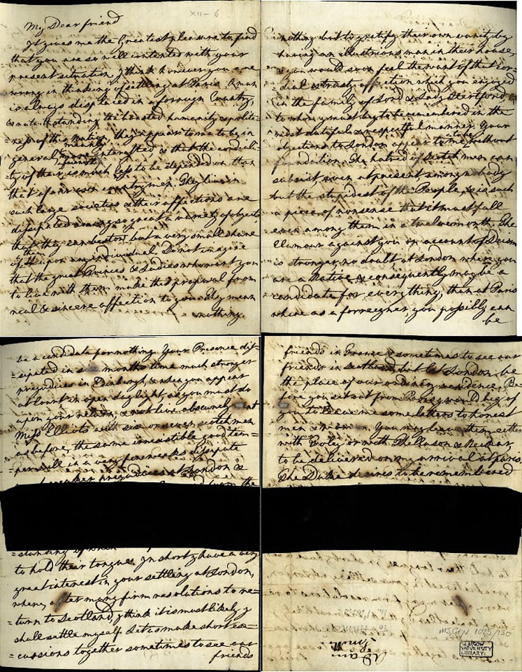
Holograph Letter from Adam Smith to David Hume. Four pages with section cut out.

Contributor: Carmen Casaliggi

Location: Archives & Special Collections, University of Glasgow Library, Hillhead Street, Glasgow, United Kingdom. Part of the Bannerman Collection donated by J. P. Bannerman and G. W. MacFarlane in c. 1937.

Description: Writing to David Hume from Toulouse in September 1765, Adam Smith forcefully tried to dissuade him from settling in Paris. Written in Smith’s hand, this letter opens with the amicable salutation “My Dear friend”, unusually intimate at this date between a younger man and an older one, and ends on page four with no subscription (final greetings) and no superscription (address). The signature on the verso has been cut out, probably by an autograph-hunter with the result that several lines are missing. However, as the sender’s name “Adam Smith”, written in Smith’s own hand, remains intact on the same page (upside down), I would suggest that the decimated part could instead pertain to the “hold their tongues” section on page three, where there were possibly allusions to politically sensitive names and material. This letter expresses a proto-Romantic nationalism and regionalism asserted in the face of transnational cosmopolitanism generated by émigré experiences and European encounters. It also epitomises the medium of exchange that extended salon culture transnationally.

Continue reading “Holograph Letter from Adam Smith to David Hume”

Beethoven’s Ear Trumpets

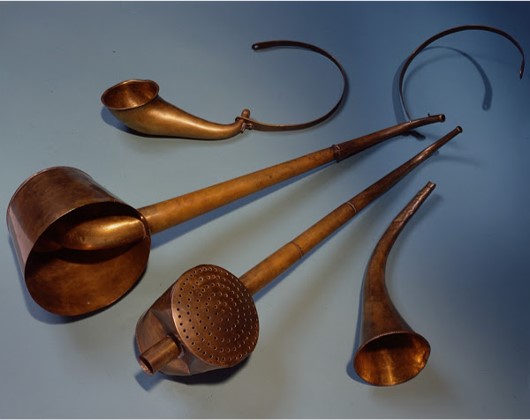
Beethoven's Ear Trumpets

Contributor: Robert Samuels

Location: Beethoven-Haus Bonn (Bonngasse 24-26, 53111 Bonn)

Description: The deaf composer is perhaps the most perfectly Romantic image of the transcendent genius. His music exists in his thought – his thought is, indeed, entirely musical. But this music exists only in the mind. The composer has no need to hear it in the phenomenal world, because he hears it already, perfectly, with the inner ear of the intellect.

Four hearing aids made for Beethoven in 1813 reside today in the Beethoven museum in Bonn, the city of his birth. They symbolise the most important element of the myth of Beethoven, a myth that was created and cultivated assiduously by the architects of Romanticism. Victor Hugo, no less, commented of Beethoven’s symphonies that ‘these marvels of euphony have sprung from a head whose ear is dead. It is as if we saw a blind god who creates suns’. As physical objects, however, the ear trumpets also testify to the pathos of an individual who today we would describe as having ‘additional needs’ rather than ‘transcendent powers’.

Continue reading “Beethoven’s Ear Trumpets”

Harlequin’s Invasion, 1803

Broadside of Harlequin’s Invasion,1803

Contributor: David Taylor

Location: The Huntington Library, San Marino, California

Description: At a glance, this looks like a standard early nineteenth-century playbill. But it’s not. In fact, it’s a nationalistic broadside published during the invasion scare of the summer of 1803 – when it was widely feared that Napoleon was readying a fleet to cross the English Channel – and it closely mimics the typographic format and language of the playbill to make its point. The work of arch-loyalist James Asperne – who ran a bookshop in Cornhill, London, with the strikingly unsubtle name of The Bible, Crown, and Constitution – this mock-playbill informs the public of a new pantomime “In rehearsal” at the “Theatre Royal of the United Kingdom” – that is, a drama to be staged in and by the nation itself. “Some dark foggy night about November next,” the playbill exclaims, “will be ATTEMPTED, by a Strolling Company of French Vagrants, an old Pantomimic Farce, called Harlequin’s Invasion or The Disappointed Banditti”.

Continue reading “Harlequin’s Invasion, 1803”

Sir Walter Scott’s Slippers

Sir Walter Scott's Slippers
Every effort has been made to secure permission to reproduce this image from the Edinburgh Writers’ Museum.

Contributor:  Barbara Schaff

Location: Edinburgh, Writers’ Museum

Description: These slippers were gifted to Sir Walter Scott in 1830 by a friend, Lady Honoria Louisa Cadogan, and her two daughters Augusta Sarah and Honoria Louisa. Like Byron’s and Shelley’s locks of hair, Walter Scott’s slippers are objects which point to the physicality of their owners. They are also signifiers for the appreciation and devotion invested in a revered male Romantic author. When Lady Cadogan and her daughters visited Scott in his home, Abbotsford, in the Borders, they were appalled at the state of his footwear – perhaps Scott’s appearance reminded them of the description of the unkempt Minister Josiah Cargill in St Ronan’s Well (1823), “whose feet were thrust into old slipshod shoes which served him instead of slippers”. Back home, Lady Cadogan’s daughters crafted spectacular slippers for him, allegedly using a centuries’ old tartar design going back to Ghengis Khan which had come through Lady Cadogan’s family. The slippers were sent to Scott with the following note: ‘The only thing we did not admire at Abbotsford was a (pair) of ugly, uncomfortable slippers we saw in (your) study so my daughters hope you will replace them by theirs.’ (https://www.historyscotland.com/news/sir-walter-scotts-slippers-go-on-display-at-the-writers-museum-in/)

Continue reading “Sir Walter Scott’s Slippers”

The Selborne Yew

The Selborne Yew

Contributor: Fiona Stafford

Location: St Mary’s Church, Selborne, Hampshire

Description: The great yew tree at Selborne features in one of the Romantic period’s best-known books: The Natural History and Antiquities of Selborne by the ‘parson-naturalist’ Gilbert White (1720-1793). First published in 1789, White’s account of his Hampshire parish has never gone out of print. But the long literary life of White’s book is as nothing to that of the ancient yew, which endured for centuries before being toppled by a January gale in 1990. The celebrity of the Selborne yew in the Romantic period may be seen as both idiosyncratic and as part of a wider celebration of ancient trees – and by extension ancient places and deep-rooted national culture — that especially characterised Romantic culture in Britain and across Europe.

Continue reading “The Selborne Yew”

Shelley’s Inkstand

Percy Shelley's Inkstand

Contributor: Anna Mercer

Location: London Metropolitan Archives (Keats House Collection)

Description: This inkstand is held in the London Metropolitan Archives and is part of the Keats House Collection. There are in all 47 ‘Shelleyan’ objects owned by Keats House. Some are duplicates; for example, there are several engravings of Percy Bysshe Shelley’s grave. There are a few first editions, including Frankenstein (1818) and Prometheus Unbound (1820). There are a number of interesting letters, including a letter from Percy Bysshe Shelley to Thomas Medwin from 22 August 1821. Perhaps the most impressive treasure of all is the manuscript of Mary Shelley’s ‘The Heir of Mondolfo’. Another item, a mirror which supposedly once belonged to Percy Bysshe Shelley, is now missing, ‘stolen from the ground floor hall at Keats House between 3 and 3.15pm on 4 May 1994’. And then there is this inkstand. The label that accompanies it says: ‘Shelley’s Inkstand. Said by Claire Clairmont to be the inkstand used by Shelley when writing “Queen Mab”’. In the catalogue entry, there isn’t much else. It is no longer on display in the museum but has been in storage at the London Metropolitan Archives for several years, possibly several decades. What initially appears quite a simple, uncomplicated object (are inkstands not very common in literary museums?), actually provokes new questions about the Shelley circle and its mythologisation. Moreover, the fact that Shelley’s inkstand is present in the collection of John Keats’s former home might invite us to ask how relics associated with the second-generation Romantics are preserved in specific locations, further uniting them as a distinct group of writers.

Continue reading “Shelley’s Inkstand”

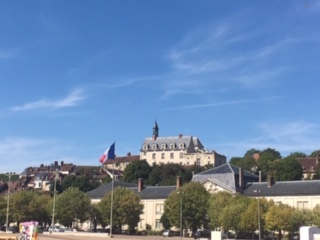
The town of Joigny, Burgundy

An image of buildings and trees in Joigny, Burgundy

Contributor: Gillian Dow

Location: Private collection

Description: The town of Joigny sits on the banks of the river Yonne, in Bourgogne-Franche-Comté. An hour and a half south of Paris, Joigny is a pretty town, which markets itself modestly as one of a hundred ‘plus beaux detours de France.’ The town’s interest, for a scholar of Romanticism, lies in its connections to Frances Burney (1752-1840), author of Evelina (1778), Cecilia (1782) and Camilla (1796). Her husband General d’Arblay was born in Joigny (1). In late 1800, seven years after he married Burney, d’Arblay learned that he had been removed from the proscribed list of French emigrés. He was hopeful that he would be able to recover £1,000 from his French property near Joigny, as well as secure a military pension. He left England – where he had been living in exile since 1792 – for Paris. Somewhat against her better judgement, on the 14 April 1802, Burney followed. She was accompanied by their son Alex, then seven, and by six-year-old Adrienne de Chavagnac, a ward of the Lockes of Norbury Park, who was returning to France to be reunited with her émigré parents. Burney did not return to England for over a decade, but when she did, in August 1812, she had the manuscript of what was to become her last, markedly European, novel The Wanderer (1814) in her possession.

Continue reading “The town of Joigny, Burgundy”

Frédéric Chopin’s grand piano

Chopin's Piano

Contributor: Mirosława Modrzewska

Location: Teatr Wielki – Opera Narodowa (the Teatr Wielki – Polish National Opera)

Description: The story of Frédéric Chopin’s piano is part of Polish Romantic cultural heritage. It has been passed down in a poem by Cyprian Kamil Norwid (1821-1883) entitled Fortepian Szopena. Norwid wrote the poem in the years 1863-64 and it refers to an authentic event in Warsaw, which took place on September 19th, 1863 during the Polish insurrection against Russian occupation.  Continue reading “Frédéric Chopin’s grand piano”

Dante’s Bones Rediscovered and Exhibited

A showcase containing Dante's Bones

Contributor: Harald Hendrix

Location: Centro Dantesco dei Frati Conventuali, Ravenna [showcase]

Description: On May 27, 1865, in the small provincial town of Ravenna, a spectacular event occurred that made headlines all over the world, from New York to the East Indies. The mortal remains of one of the greatest poets that had ever lived, Dante Alighieri, were discovered after having been lost over some 350 years. Coinciding with the celebrations marking the sixth centenary of his birth — in Ravenna and well beyond, particularly in Florence — this remarkable event fueled unprecedented curiosity, coercing the local authorities to publicly exhibit Dante’s bones and the simple wooden coffin that had contained them for centuries. To such purpose this crystal showcase was used. During one month, from May 27 until June 26 1865, the public was allowed to see what remained of Italy’s national poet, an experience never to be repeated again. While satisfying the audience’s urge to establish a direct connection to a man as highly venerated as Dante was, the exhibition of his bones also revealed something about the cult of the author. As a consequence, this episode of hero worship signals a paradigmatic instance in a field where popular curiosity, scientific interest and concerns of heritage conservation meet and clash.

Continue reading “Dante’s Bones Rediscovered and Exhibited”